The Data Management Marathon 9.0 [https://thinklinkers.com/] brought together inspiring perspectives and practical lessons, with several presentations highlighting a shift that I believe will shape the future of data governance. In this blog series, I explore these insights through the lens of my own experience in Data & AI and governance projects, connecting the speakers’ ideas with real-world examples and lessons learned over the years.
Data governance is still too often approached as a set of policies, data quality practices, metadata management, roles and controls. These provide an essential foundation, but giving data a meaningful place on an organisation’s strategic agenda requires a clear connection to business objectives.
The presentation by Olga Samunova, Data Activation Leader at Ingka Group, struck a different note for me.
Rather than approaching Data Governance primarily through frameworks and control mechanisms, her perspective focuses much more on how to make data a structural part of the business agenda. Governance then becomes not the end goal, but a means of connecting strategy, accountability, collaboration and decision-making.
That also requires a different approach. Instead of starting by asking which governance processes or tools we need, we should start with questions such as:
- Which business objectives do we want to support?
- Which decisions do we want to improve?
- Where is data holding the organisation back today?
- Who needs to take accountability?
- And how do we make Data Governance part of the organisation’s day-to-day operations?
I believe this shift is important because it brings Data Governance much closer to the business.
From Governance Programme to Change Programme
A Data Governance initiative traditionally starts with a framework: defining roles, establishing policies, implementing a data catalog and defining data quality rules. But that does not automatically put data on the management agenda.
The most difficult step is usually not so much designing the framework, but rather ensuring that the organisation actually acts on it.
Who resolves the differences when two departments use different definitions? Who is accountable when data is not reliable enough to support a business process or AI model? Who decides which information may be shared? And who ultimately determines which risks are acceptable?
With this frame of mind, Data Governance increasingly becomes an issue organisational alignment and change management. This is exactly where I see the relevance of Olga Samunova’s approach: putting data on corporate the agenda is not simply about organising governance. It is about making data part of the conversations in which business priorities, investments, risks and change are determined.
Are We Starting to See This in Belgium as Well?
Interestingly, this perspective is no longer limited to presentations and international discussions. We are beginning to see elements of it reflected in the roles Belgian organisations are recruiting for today.
In a recent vacancy I came across for a Data Governance & Compliance Officer provides an interesting example.
The first responsibility is not managing a data catalog or defining data quality rules. The role is expected to define, maintain and communicate the Data Governance roadmap, aligned with business objectives and regulatory priorities.
That may seem like a minor detail, but I believe it says a great deal.
Data Governance is explicitly being connected to the organisation’s business objectives.
The rest of the job description reinforces this broader positioning. The role operates across Business, IT, Security, Risk, Legal and Privacy, combining governance with compliance, ownership, change management, data literacy, maturity assessment and representation in strategic programmes.
All of this paints a picture that is fundamentally different from the traditional image of a Data Governance Officer like we have seen it in the past.
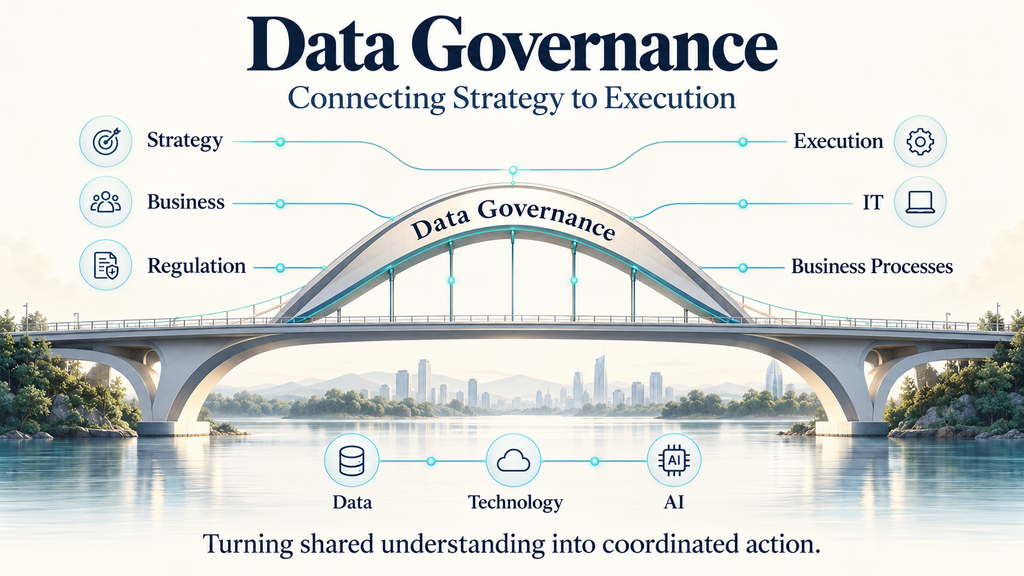
The Governance Professional Becomes a Bridge
What particularly stands out to me in this job description is the emphasis on connecting different parts of the organisation. The governance professional is expected not only to understand Data Governance, but also to work effectively with the CISO, DPO, Legal, Risk, Security, architecture teams and the business.
This showcases the evolution that I believe Olga Samunova’s perspective draws attention to.
Once data truly becomes an integral part of the business agenda, Data Governance can no longer operate as an isolated discipline.
From Governance to Community Building
Another element of this job description is at least as interesting: community building and knowledge sharing are explicitly becoming part of Data Governance.
The role is expected not only to define governance processes, but also to lead the Data Governance Community, provide training and guidance to different data roles, and contribute to training materials and articles. At the same time, the organisation expects data knowledge and awareness to be developed at different levels — all the way across data roles to business and management.
This may appear to be a supporting responsibility, but I believe it touches on one of the biggest challenges in Data Governance.
A framework can be designed centrally. A data culture cannot.
If we genuinely want to put data on the business agenda, people need to understand why governance matters with respect to their own decisions and responsibilities. That requires communication, education, and above all, an active community in which knowledge and experience are shared.
This also changes the role of the governance professional. In addition to defining policies and responsibilities, that person increasingly becomes a community builder, facilitator and communicator. Someone who makes Data Governance visible and relevant across the organisation.
Here too, I see a clear connection with Olga Samunova’s approach: activating data is not only about organising processes and responsibilities, but also about mobilising people to put them into practice.
From Documentation to Accountability
Ownership therefore takes on a different meaning as well. Appointing a Data Owner is relatively straightforward. Ensuring that this person genuinely understands the associated accountability —and has the mandate to make decisions— is much more difficult.
The same applies to governance boards, communities and stewardship. A governance framework can exist perfectly well on paper while having very little impact on the organisation’s day-to-day operations.
The real test comes when conflicts of interest arise, when data proves insufficiently reliable, regulation constrains an initiative, or when different departments favour opposing decisions.
That is when it becomes clear whether governance has truly become part of the operating model.
Compliance Broadens the Playing Field
The regulatory landscape also makes this broader approach to governance increasingly necessary.
While GDPR was the dominant reference point for many years, organisations now face a much broader regulatory landscape. The job description explicitly connects Data Governance with GDPR, NIS2, the Data Act and the AI Act.
As a result, governance is becoming less about simply managing data and increasingly about determining the conditions under which organisations can use, share and apply data in new ways.
That requires much more than knowledge of a governance framework. It requires the ability to translate regulation into concrete processes, responsibilities and decisions.
The Next Step: Data Sovereignty
One topic is not explicitly mentioned in the vacancy, but I believe it will become increasingly important: Data Sovereignty.
The discussion is no longer only about who has access to data. Organisations also need to understand where their data resides, which jurisdictions apply, how dependent they are on vendors and technology platforms, and how much effective control they retain over their data.
Data Sovereignty therefore brings together several discussions that are still often treated separately today: governance, cloud strategy, security, compliance, architecture and vendor dependency.
This further reinforces the need to look at Data Governance much more broadly than just policies and controls alone.
From Vision to Belgian Reality
For me, this is ultimately what makes the combination of Olga Samunova’s presentation and this concrete Belgian vacancy so interesting.
Olga presents a vision in which Data Governance does not start with technology or documentation, but with the challenge of putting data structurally on the organisation’s agenda.
When we then look at what organisations actually expect from a Data Governance & Compliance Officer today, we can see several elements that reflect that shift:
- a roadmap linked to business objectives;
- cross-functional responsibility;
- governance connected to regulation and risk;
- ownership and community leadership;
- change management and data literacy;
- maturity and measurability;
- representation in strategic programmes.
These are signals that Data Governance is gradually evolving from a specialised data function into a broader enterprise capability. Perhaps this also changes the fundamental question we should be asking about Data Governance.
No longer simply: “How do we ensure that our data is properly managed?”
But increasingly: “How do we organise data, accountability and decision-making so that data genuinely contributes to the organisation’s objectives?”
If this movement continues, it will not only change Data Governance. It will also change the profile of the people we need to lead it.


